Bluefin tuna hatchery success: A first step in resurrecting San Diego, California as the “Tuna Capital of the World”
San Diego, CA, once was known as the “Tuna Capital of the World” (Ellis, 2008). Following the first tuna cannery startup (1911), the city became a world leader in commerce associated with tuna fisheries. By the 1960s, San Diego’s third-largest economic enterprise would be tuna, superseded only by the U.S. Navy and aerospace, employing over 40,000 San Diegans. After years of overfishing and the tuna embargo, this commerce has all but disappeared from Southern California. In 2016, the National Marine Fisheries Service was petitioned to have the Pacific bluefin tuna, Thunnus orientalis (PBFT), listed under the Endangered Species Act. Assessment by the 2016 International Scientific Committee for Tuna and Tuna-like Species indicated that the stock was “alarmingly overfished”, yet still undergoing high rates of exploitation (Craig et al., 2016). At that time, the Inter American Tropical Tuna Commission also adopted the strictest PBFT conservation measures in history for the Eastern Pacific Ocean (EPO, IATTC, 2016).
These actions combined emphasize the dire situation of the PBFT – and the need for restoration research. Reactive regulatory measures alone have limited capacity to protect endangered populations of fish. While science provides suitable fishery restrictions, implementing these is extremely difficult. The PBFT stock is harvested by several countries and over 80% of the capture occurs in the Western Pacific Ocean (WPO). When forage fish resources at WPO become overexploited, a hunger-driven trans-Pacific PBFT migration is triggered to the EPO (Matsukawa, 2006). Japan’s use of large amounts of wild-caught juvenile PBFT to stock tuna ranches adds to the overall fishing pressure and management complexity. Since tuna ranching started, there has been an exponential increase in the volume of baitfish used to feed tuna in net pens worldwide (WWF, 2005). This is the case in northwest Mexico where most purse seine sardine catches are destined for tuna ranching operations (del Moral et al., 2010). A new assessment delivered to the Pacific Fishery Management Council
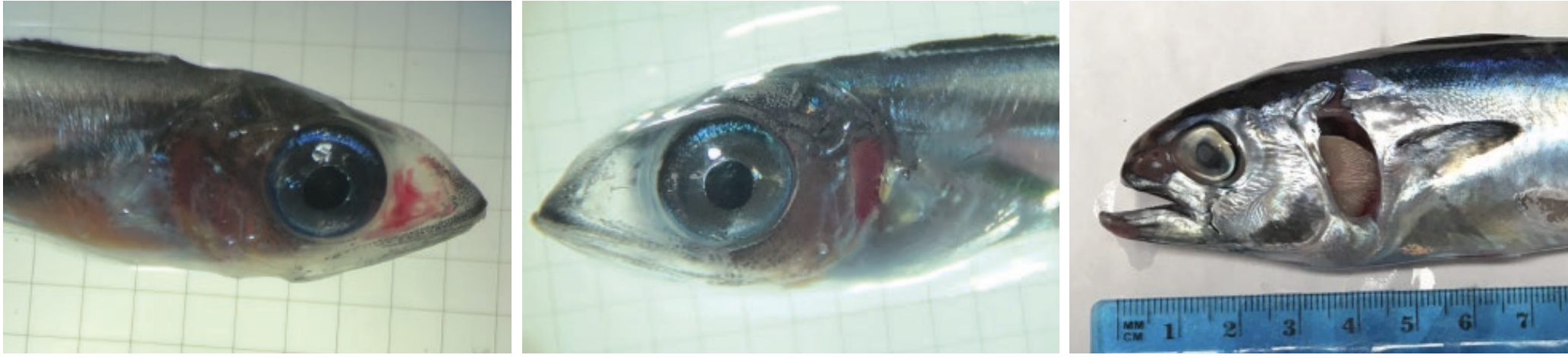
Figure 1. Snout hemorrhage after collision (a) and operculum malformations (b and c) are common issues affecting survival in bluefin tuna larviculture.
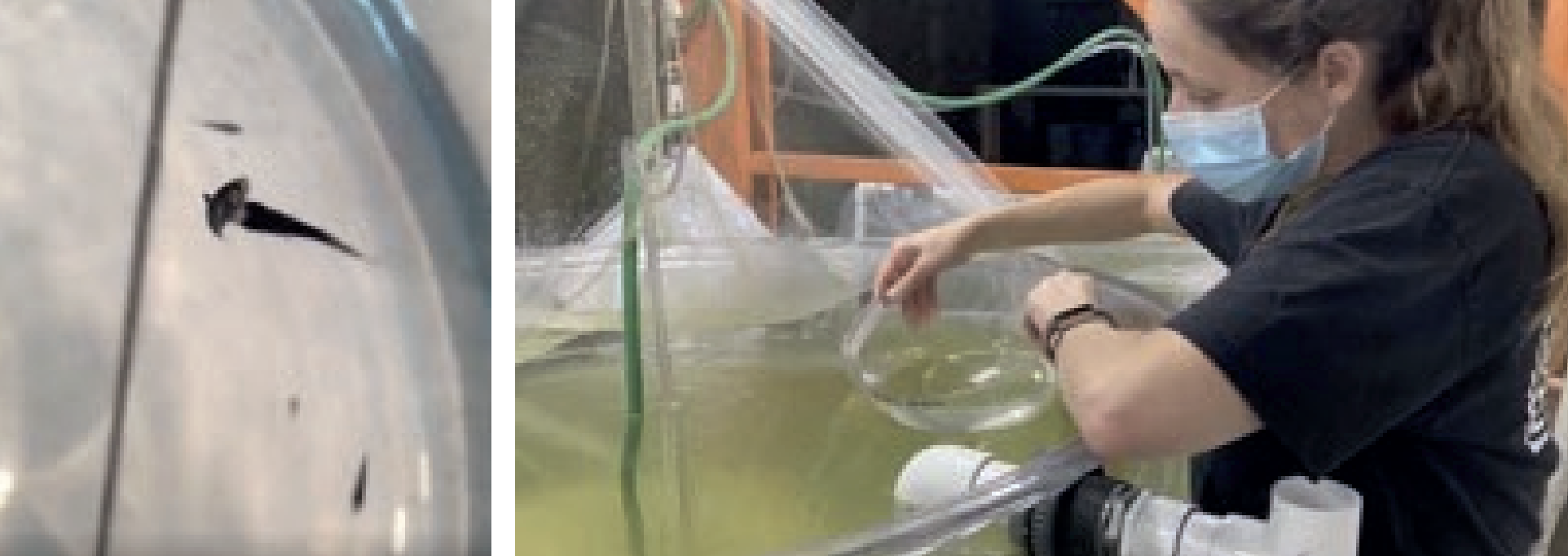
Figure 2. Cannibalism (a) may be controlled with regular sorting and grading (b) of tuna larvae.
(NOAA, 2020), indicated that the Pacific sardine (Sardinops sagax) stock – a fishery resource shared by Canada, the United States and Mexico – remains at extremely low biomass. In the United States and Canada, the commercial fishing for Pacific sardines is prohibited because the population is below precautionary levels. Ichthus Unlimited (IU) is a small and diverse company founded in 2015 by American entrepreneurs. Its interdisciplinary research team is at the forefront of tuna research and believes a proactive strategy may work best in resolving these important and challenging problems. With a three-pronged approach, based on controlled reproduction and larviculture of PBFT, sustainable tuna feeds (Buentello and Albertson, 2018) and novel marine cage technology, IU aims at bringing bluefin tuna back to the “Tuna Capital of the World”. Here we share the recent success of tuna hatchery research and, as of the submission of this article, bluefin tuna juveniles > 140 days post hatch (dph) are thriving at IU’s hatchery in San Diego. The generous funding support from the Foundation for Food and Agriculture Research, the Illinois Soybean Association, The Ohio Soybean Promotion Council, the Minnesota Soybean Research & Promotion Council, and the USDA-NIFA-Small Business Innovation Research Program is kindly acknowledged.
Egg sourcing and global logistics
Although the target species for IU’s San Diego hatchery is the PBFT, this technology can be applied to other scombrid species. Therefore, a complex network of international suppliers of fertile eggs of PBFT, Atlantic bluefin tuna (ABFT, T. thynnus) and yellowfin tuna (T. albacares) has been established to improve global shipment and husbandry protocols. Even during the COVID-19 pandemic, which has brought extremely challenging freight conditions, these protocols proved successful with after-shipment survival exceeding 80%. Importantly, only species endemic to a particular area will be cultured using IU fish in that area. For example, PBFT in the U.S. West Coast and ABFT in the Gulf of Mexico and the U.S. East Coast.
International and domestic live feed procurement network
After tuna eggs hatch and consume the yolk, the first feed tuna larvae are composed of small live zooplankton and other fish larvae from a different species, until they can be weaned to an artificial diet. A unique group of cooperating institutions and vendors was formed including domestic collaborators in California, Texas, Mississippi and South Carolina and international partnerships in Japan and Norway. Just in time, logistics were executed such that timely delivery of organisms of the right developmental stage were made available to serve as larval tuna feed.
Preliminary research on weaning diets
In collaboration with the Spanish Institute of Oceanography (IEO), Texas A&M University, Scripps Institute of Oceanography (SIO) and other academic institutions, IU has been conducting targeted research to optimize weaning diets for larval tuna and juveniles. Existing live feeds and artificial feeding protocols for larval and juvenile tuna species are associated with poor survival, growth and stress. Low swim bladder inflation rates, surface and sinking deaths, dispersed sizes, malformations and tank wall collisions are common issues (Buentello et al., 2016a). Mortality observed during the first stages of life is partly due to nutritional deficiencies (de La Gandara et al., 2010; Partridge, 2013; Buentello et al., 2016). A preliminary trial comparing commercial (Magokoro, Sujico and Sparos) vs IU diets over a 4-week feeding period resulted in IU diets supporting a significantly (P < 0.05) higher survival (55%) compared to the other test diets (< 35%). Other studies have shown a wide range in weight gain variation with no significant differences among fish fed various experimental diets. Because growth and survival are the two most relevant performance indicators in larviculture of fish, these results demonstrate that IU diets can deliver equal performance and superior survival under standardized rearing conditions.
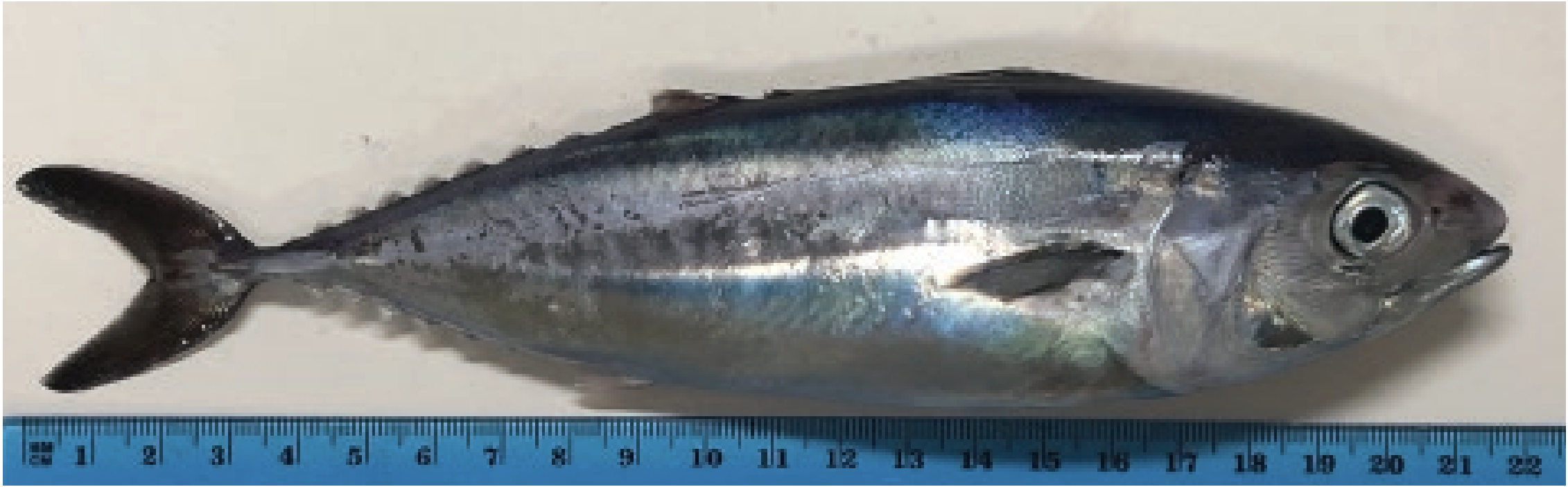
Figure 3. Bluefin tuna 80 days post-hatching (~111 g and 22 cm total length).
Problems and perspectives
Preparation for the 2020 season started Q1 2020 with a first shipment received on July 11, approximately 30 hours after fertilization. Upon arrival, water parameters in the egg container were 19°C, 37 ppt and 150% saturation for water temperature, salinity and dissolved oxygen, respectively. After acclimation to hatchery conditions, eggs were stocked at a density of 18 eggs/L in 10, 500-L round tanks. Throughout the rearing period, average water quality parameters have been maintained at 25.6°C, 160% and 33.2 ppt for water temperature, dissolved oxygen saturation and salinity, respectively. Flow rates were progressively increased from 0.00007 to 0.5 L/min from week 1 to 13. At this point, fish were transferred to larger systems at NOAA’s Southwest Fisheries Science Center (flow-through) or to IU’s 32,000-L closed recirculating system. Photoperiod was regulated such that 24 hours of light were provided during the first 10 dph followed by a natural photoperiod until 25 dph. Thereafter, light irradiation was regulated in a diel manner, with intensity adjustments for day and night time. Survival among tanks was highly variable with average values ranging between 1.0 and 0.1% 60 dph, which is lower than that reported for bluefin tuna eggs which were not subjected to trans-oceanic shipping (Satoh et al., 2013). Survival issues arose in part from shipping temperatures which may have resulted in malformations (Fig. 1) as reported for other scombrid species (Wexler et al., 2011; Guillen et al., 2014) and/or nutritional deficiencies (Fraser & de Nys, 2005; Cobcroft & Battaglene, 2013) which affect larval stages in various marine fish when biological organogenesis and morphogenesis processes occur (Mourente & Toucher, 2009; Buentello et al., 2016b). These problems may result in reduced biological performance (e.g., diminished growth rates and survival) and in the production of unmarketable fish, but can be addressed through management and nutritional interventions.
Tank collisions (Fig. 1) were controlled with appropriate illumination as well as limiting personnel access to rearing tanks; whereas, cannibalism (Fig. 2) was controlled by maintaining a suitable amount of prey items at all times as well as semi-continuous sorting and size-grading of fish.
Future research
Although scombrids are extremely prolific, multiple batch spawners (Schaefer, 2001), research underlying causes of juvenile tuna mortality is still very much needed. IU’s first attempts at larviculture met with relatively low survival rates. Additional research is required to determine the potential impact of the nutritional quality of live feeds, and other factors linked to diminished survival. However, it is reasonable to expect in the near future that PBFT fertile eggs originating from IU oceanic cages near San Diego (~15 miles SW) will result in significantly increased survival rates. The ontogeny of endothermy, as well as vision development, appears as a highly profitable area in tuna research with practical applications in larviculture. To hunt for prey in deep and cold water, some tunas can maintain a warm body temperature that supports their central nervous system, key organs and eyes. The visual ability supported by a heated retina in deep cold waters makes these fish efficient predators (Fritsches et al., 2005). Studies on the ontogeny of endothermy are been jointly pursued by researchers at California State University Fullerton and IU, although studies on vision development in juvenile tunas are presently limited, in collaboration with SIO researchers, IU plans to address this topic as it affects a period in the life of tuna when significant mortalities still occur
Conclusion and perspectives
Current methods in tuna ranching based on wild-captured fish for the stocking of net pens and the feeding practices using baitfish severely limit its sustainability and full potential, running contrary to best management practices and environmental responsibility. For tuna aquaculture to become sustainable, various factors must be controlled. At minimum
a) suitable environmental conditions need to be provided [in ascending order, for survival, growth and reproduction],
b) a reliable source of hatchery-raised juveniles for net pen stocking,
c) a complete, balanced feed must be commercially available for all developmental stages and – becoming more relevant every day –
d) control over waste discharges,
e) disease prevention and management and, not least,
f) have economic feasibility.
Today, the tuna ranching industry is arguably the highest value form of aquaculture in the world and the associated burgeoning of support industries and economic multipliers may have a significant commercial impact and societal benefit to coastal areas in southern California. Therefore, the re-establishment of a tunarelated industry in San Diego makes sense if we can provide hitherto unavailable technologies that carefully balance the sustainability of resources, the carrying capacity of the marine ecosystem and the economic development needed as impetus. Today, IU offers science-based practical solutions to all factors listed above. Execution of these solutions and the shift from R&D to commercial depends on a successful capital raise with attractive returns for investors, which is something IU is currently pursuing.
References available on request